faux Mercury

I played at Mercury Bar the other night for a 20 minute or so set. Thanks to everyone who came down to hear the great poetry, improv, and me. I wanted to keep things that could go wrong to a minimum, so I did not try to record, but today for kicks I did record the same thing, more or less, as what I played at Mercury and two other songs. Here they are. Just load it in the background while you do something else.

Facebook people will need to go to http://way.net/music/audio/mercury%20set.html or else come to the blog at http://waymusic.way.net in order to hear.

Published

The Missing…

Here is the missing flyer for Wednesday’s MIA night at Mercury. Starts at 7:30. Hope you can make it! The music in the link is from when I was in Philly. M said it sounded funereal.

MIA Wednesday April 14 at Mercury
Published

playing at Mercury Bar the Weds after next

I’ll be playing at MIA at Mercury Bar for a short set along with a great bunch of pets and other types like that the Weds. after next, starting time 8 PM. Guaranteed to entertain and amuse. In honor of my extreme case of overwhelment and disorganization, I’ll post a new song every time I figure out a new detail as far as the date and event and participants. This one is kind of fun…if you set it on repeat, it seamlessly starts over again where it ended. It is called circ’later.

Published

looping

[2/18…fixed link to mp3]

For my friends who might not know, looping is the one of two ways to play with yourself live and not get arrested for it  (the other way is to lucubrate).  The term comes from the old way of doing it, which was to take a piece of reel-to-reel tape and make an endless loop out of it by taping its end to its beginning and then running it between two decks set however far apart the loop would stretch.  I’m forgetting exactly how it worked, but you could basically record on one of the decks and it would playback a few seconds later on the next one while you were still recording on the first one.  Depending on the deck, it could be set up for sound on sound, so that the recording got denser as you proceeded, or it would regenerate every time it went around if not.

Echoplex first managed to fit the whole contraption in a single box, but the tape heads were only a few seconds apart at most.  The cool thing was to be able to move the tape heads while playing, giving a great flying saucer/swooping effect (heard about four minutes into this song by the Mess) and generally good for dubbing out.

echoplex
echoplex

It got stolen or I got drunk and sold it or something, and the Mess self-destructed fairly quickly, so the old echoplex is one more of a series of musical things I wish I never sold or lost.  I was more or less broke through the rest of the 80s and 90s, so I missed the new digital loopers which for a thousand bucks or so would get you maybe thirty five seconds of loop. I started messing with vst plugins and software loopers in the late nineties.  I could never afford a mac or protools, instead slowly worked my way into the wild world of windoze plugins (can you say “crash?”).  Discovering Plogue Bidule changed everything for me, and that is what I use for live playing and spontaneous recording today.

Software loopers come in many flavors and have reduced the price point from thousands of bucks to zero, as long as you have a computer and a sound card.  I still have files from an old program called ambi-loop which was not half bad, but now my main loopers are mobius, when I can keep it running, an ancient, idiosyncratic plug called ellotronix which has some cool features (here hear), and a thing called Loopy llama, which is stable and never seems to fail.  Mobius is the most advanced, being a dead knockoff of the thousand dollar digital echoplex except that the loops are however long your computer can stand it and you can stack up eight of them instead of just one like the hardware version.  I also really like arc-dev’s free drum looper ellipsis (here/hear in action).  It is versatile and easy to control externally.  I like setting that up against another “accent” percussion loop in bidule’s looper, which lets you only play portions of a loop and leave the rest silent (hear here).  That last one also uses a one-bar looper called repeatler with a neat feature of letting you slice chunks out of the loop as well as put them in.  The mix is not finished, so it is a bit long.  Here is a shorter one using repeatler if you are either in a hurry (just listen to this) or have too much time on your hands (listen to both).

If you like any of the music, I have tons more posted at Way Music, about half of which uses loops in one way or another.

Published
Categorized as music

the actual state of things

Well, I adjusted the Chipsounds post to reflect the somewhat sad state of the world, at least in the corner of it where I am living for a few months. And give another listen to the renamed first song, which I remixed much better, I think. Most of the work was on the balance between the channels, with a light touch of mastering effects and some motion added in a few spots in the mix via panning and AZ Audio’s ADoppler2. Remember, Facebook readers need to go to the blog to listen to the music.

Published

Atlas Sound / Broadcast

Waiting for the doors to open. Never heard of the Selmanaires. Broadcast does some cool Lo-Fi stuff. I’m curious about Bradford Cox’s Atlas Sound. He is the singer for one of my favorite bands, Deerhunter.

The venue is a Unitarian church. I’m up in the first pew. Praise the humanistic and benevolent, somewhat secularized deity of the Unis. Hard to believe that they are direct descendants of the Puritans. Put Bradford Cox in a dress (but alas no dress tonight) on your city on a hill and smoke it! Great acoustics, but probably all the natural reverb makes doing sound hard.

The Selmanaires are first up after a long chilly wait for the doors to open. Keys, drum machine with a live percussionist, guitar, serviceable vocals with good harmonies, and bass. Kind of a Syd era Floyd if they had been from eighties Birmingham (England), been signed by Factory Records and had digital stuff.

Atlas Sound’s setup looks like it includes a Super 8 projector at a funny angle, an extension to the stage, and a folding table full of effect boxes off to one side, but maybe that’s Trish from Broadcast’s stuff. Hmm the thing I thought was a projector is an ancient synth and it appears that Broadcast rather than Atlas Sound will play. And the projector is way better than Super 8. The sound is very loopy sequency psychedelic, as are the visuals. With the vintage gear sound and the trippy visuals, this reminds me of that movie in eigth grade where they tried to to scare you away from drugs by showing a bad trip but it actually looked kinda cool — and this is way better for you than the drugs, and not as campy as the movie. Then out of that comes the semi-sublime (sub-sublime? and what’s so great about lime anyway?) “Corporeal“. Some sound problems are getting Trish frustrated. A little tension in the air. She might smash something. Oddly, you can see the anger in her gestures and hear it in her voice but not from the equipment she hits because all is electronic and the touch never makes it into the sound. Velocity 127 and that’s it. Ahh all seems well again.

Now she has broken out an instrument I’ve only ever seen in my home, a triangular lutey thing tuned and fretted like a plucked dulcimer but played like a guitar. It cuts through a mix like a banjo. I thought they stopped making them, but Trish said after the show that hers was new. They are called strumsticks . The story I heard was that they were made for a few years by a guy in PA who got bought out by Martin Guitars. Martin had made a similarly shaped travel guitar for which they were afraid of getting sued. They took the strumstick thingy off the market and continued to make their not so great sounding travel guitars. All that is hearsay, and Bob McNally, the guy who makes them, doesn’t go into the history on his site, so who knows if I got the story right. Good to see they are back out. And it appears McNally is making the travel guitars for Martin, so maybe they are not so bad anymore.

Atlas Sound is in fact setting up. It is hard to tell if it will just be him or an actual band or members of the Selmanaires — they are from Atlanta too so maybe they share members. There’ two of them now, Bradford and the keyboard player from the first band. Moody ballad. As usual, interesting words. Uh oh, he’s gotta harmonica. Bad sign. But here comes the rest of the first band to back him. Jury is out…

It seems Mssr. Cox is after a bigger prize than Deerhunter, going for a more Americana, less reverb-drenched psychedelia sound. Oops but now he’s set up a loop on his guitar, a little poppy, a little sickly, and then gone off to play the drums and sing, ending it with a wash of echoed vocals out of which emerged the original guitar loop but backwards. I love when that happens. More echoey stuff. Ok, now not so Americana as much as Harry Smith weird updated for the new millenium. He does the Juana Molina thing of integrating acoustic and electronica into seemless loopy textures. Maybe he is trying to do the Wilco weird Americana route but starting from weird instead of Americana. Oh, and the music and words are several shades darker, like when he says “this is the last song,” followed by a pregnant pause before letting out “tonight.” Phew, I was a little concerned.

I got to talk with Bradford after the show for a minute. He reassured me that Atlas Sound was in addition to, not instead of, Deerhunter. Phew, I was a little concerned. Great show, in the opinion of someone who started out skeptical.

Published

8 bit lo-fo chipsounds

If you are interested in digital guitar, check out the Digital Guitarist YouTube Channel. Subscribe here.

Just got David Vien’s obssessive labor of love, brand new from over at Plogue.com, Chipsounds. David has been messing with computers and sound since the early 80s and was missing his early love, all the various 8 bit sounds built into the computers, gaming consoles, and arcade games of the day. To work within the limits of the chips, programmers had to resort to a number of musical hacks to get things done, and operating within those limits, they invented a bunch of techniques that were original but tied to the limitations. When the limits went, so did the chip sounds and along with them, many of the techniques. Vien’s has gone through his collection of vintage chips and reconstructed the sounds and some of the techniques, even including chip fails, or the sound of a cartridge when it was only partially plugged in.

Chip sounds are going through a retro hip phase. The first I heard them was in a Beck song, I think “Girl” and then in a couple of great songs by Broadcast, whom I am going to see, along with Atlas Sound, in just a few minutes.

Now I got my first computer only in 1989, and I did not get one with a sound card til 1995, so I’m not a chip geek. Let’s just say I wasn’t doing computers in the early 80s. I’m also a guitarist away from home with just my trusty Godin guitar with a built in synth controller, so I don’t play synth’s quite the same way as a keyboard player. And I am quite certain I break several 8-bit “rules” before I even plug my guitar in. That said, I kinda like the tune I’m putting up today.

I recorded this song, “phillies in seven not this year” using seven tracks of nothing but Chipsounds played from my Godin guitar’s synth pickup. The only cheat was to run the Chipsound drums through Mokafix’s Mutine and CacoFx’s deceased AffectedME. Its is recorded and mixed in Bidule, although looking back it would have been easier to do it in Sonar, which tends to deal with standard multitracking better. Bidule’s real strong point is as a live instrument with lot’s of routing possibilities. Just for kicks is another version, “phillies in four maybe next time,” also all guitar (except for the drums) and all through Bidule. I’m in Philly for a few months, what can I say! The groovy guitar controlled organ, and the bass, are presets from Cakewalk’s excellent Dimension synth. The drums are from Nusofting’s DK+, an excellent and very reasonably priced drum sequencer/synth. If you listen carefully, both versions borrow changes from an old Gun Club hit, and the Chipsounds version borrows a well-covered Monkees song as well as a little surf rock for the bridge. Can anyone name the three songs? If you name them I’ll post versions of them.

Chipsounds costs a few bucks ($75) and has no demo version, but I have been a happy Plogue customer for a while. Bidule is one of the better few bucks I’ve spent. The plugin is just at 1.0, but plogue supports its flagship project, Bidule, quickly, thoroughly, responsively, and with lots of updates, so I expect some of the clumsiness of the interface will be worked out and a few more features worked in before long.

If I get the time, I will go over the pros and cons of some other chippy Lo-Fi plugins that are free so that the poor can fell the LoFi love too.

Remember if you are on Facebook that you have to come to way music to listen to the songs. And for everybody, don’t forget to check out the rest of the blog and way music. Off to the show, which I also went to last night when it wasn’t!

Published

Welcome us home to Honolulu!

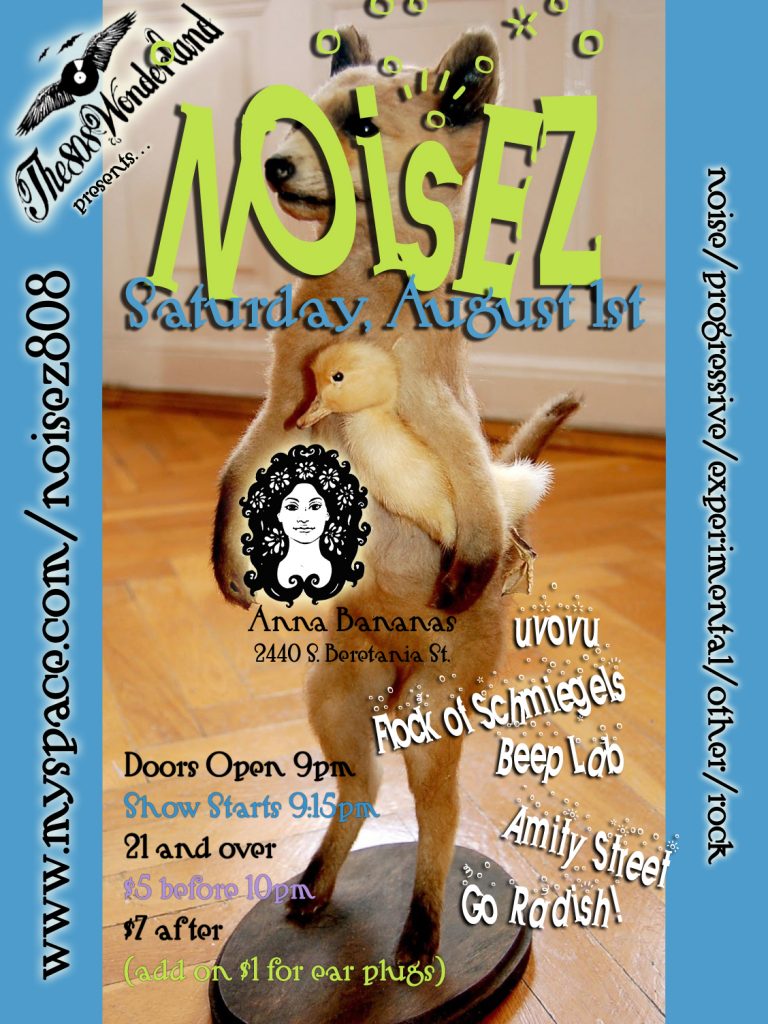
We’ll be back in Hawaii August first at long last! Come celebrate at Anna Bananas, where I’ll be playing as BeepLab (Bengali for revolution!). I’ll be going on some time after 10:30. It’ll be all instrumental from me. Here is some of the stuff I’ve been playing lately:

. . . and below is the poster with the details. I hope you all who are in Honolulu can make it!

noisez_080109

Published

Lethal suburbia

My woman of color partner had an allergic response to Wilco live the other night and claims chronic ankle pain from standing around all night to add injury to her insulted ear drums. She more or less agreed with the Village Voice’s recent savaging of the band as insipid white suburban angst, with no edge or danger — “nice” and safe. Admittedly, her presence accounted for about a third of the people of color we saw at the concert, but I think the Voice mistakes suburban and white for actual rather than discursive safety. While the two-kids-two-cars-and-a-dog-go-to-college-get-married-get-a-job types do more or less prevail, there are a whole range of folks who fall through this seive-like stereotype that few hear or talk about.

Let me demonstrate with some examples from the suburb I cleared the hell out of the moment I turned 16. In the family a few doors away, one went to jail, one is a quadrapalegic from a car accident, one committed suicide. Down the street, “Joe” flipped his souped up Charger, killing himself and injuring as well as traumatizing his girlfriend who was sitting next to him. “Mike” used to like to park his car on the railroad tracks and party. One night he went by himself and got hit. I could go on, and myself, I’m lucky to have survived my teens. I could also recount the quiet desperation many of those outsiders live in as adults.

Not much in the way of guns and gang-banging and urban “dangerous” rap fodder like I guess the Voice author respects, but still pretty lethal. A few of us get out somehow, becoming rock stars or college professors, in spite of long odds. And white privilege certainly offsets the loss of more marketable urban survivor stories (no one wants to admit that there is an underside to suburbs any worse than a little anomie and boredom, part and parcel of the denial and empowered ignorance that makes whiteness so weird and powerful). So when Tweedy sings about ghosts being born and other more or less veiled references to lethal suburbia it only seems safe if you pretend it is all symbolic and mere angst. In other words it seems safe if you never lived there.

Published